Drafted by an LLM, reviewed and edited by TitanTrainers15 and others.
A threshold tier is a named stat cutoff that an IV spread has to clear
to reach the next meaningful battle outcome against a notable opponent. This
page is about the Threshold Tiers section of a deep dive - what the
cards show you, what the numbers mean, and how to use them when you’re
picking which IV to invest in.
What a tier card actually shows
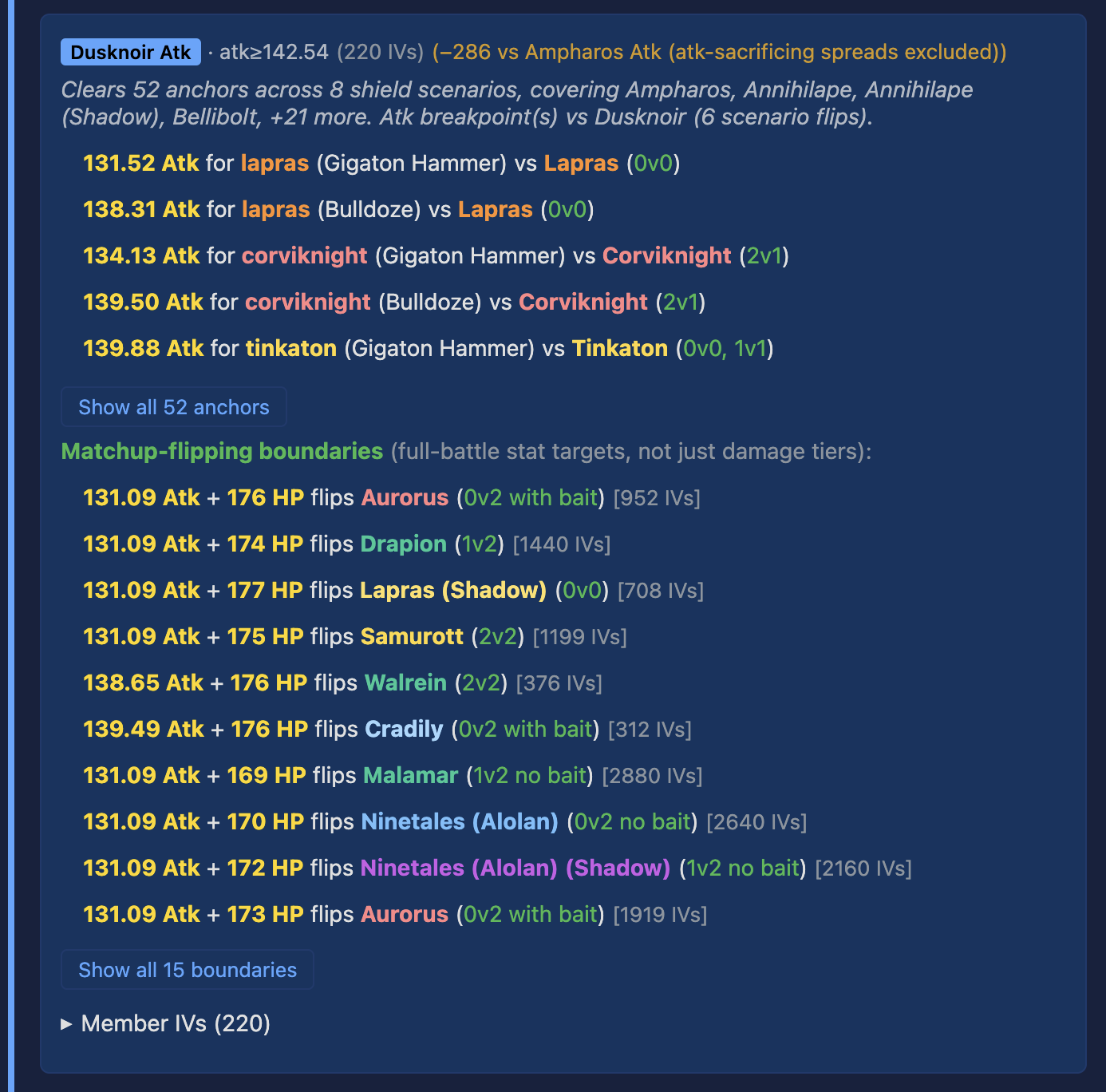
The Dusknoir Atk tier card from the Tinkaton UL
dive. Header: the tier-name badge, the stat cutoff
(atk≥142.54), the member count (220 IVs), and a
parent-tier diff callout explaining what this stricter tier trades
vs. the next looser one. Below the header: two lists. The
anchor bullets (top) are pure damage breakpoints
("X Atk flips Y against Z"). The Matchup-flipping
boundaries (bottom) are full-battle boundaries that
usually include an HP co-floor - the full 1v1 outcome flips at
131.09 Atk + 176 HP, not just the damage tier. The
distinction matters: anchors tell you what a move does, boundaries
tell you what a whole fight does.
Three things to read off the tier card header in the screenshot:
The tier name. It’s usually “(opponent) Atk” or “(opponent)
Bulk” or “Fortified (opponent)” - a shorthand for “this tier is
defined by a specific breakpoint or bulkpoint against that
opponent.” Expert-authored tiers keep their authored names instead
(e.g. “GH Great” / “GH Good” on the Tinkaton dives). In
the screenshot, the
Dusknoir Atk
badge means this cutoff was derived from a damage breakpoint
against Dusknoir.
The stat cutoff. The part after the middle dot is what an IV
spread has to clear to be a member of the tier. atk ≥ 142.54
means the IV spread’s effective attack stat (base + IV, at the
level the CP cap allows) has to be at least 142.54. A tier can have any combination
of atk ≥, def ≥, and hp ≥ cutoffs; stats without a cutoff
aren’t restricted.
The member count in parentheses.220 IV spreads means that
many of the 4096 possible IV spreads clear this tier’s cutoffs. The
higher the number, the easier the tier is to hit with a catchable
IV spread; the lower, the rarer.
Below the header, each card carries a list of anchor bullets - the
specific matchup flips this tier buys you. The Dusknoir Atk card in
the screenshot lists Lapras, Corviknight, and Tinkaton bullets
alongside the namesake Dusknoir bullet - because clearing a stricter
atk cutoff like 142.54 automatically clears every looser atk cutoff
(131.52 Atk for Lapras, 134.13 Atk for Corviknight, etc.) at the
same time.
Tier vs anchor vs category
These three words show up near each other and it’s worth being precise:
An anchor is a single per-opponent rule. “Your attack has to be
at least X to cross Lapras’s damage breakpoint” is one anchor.
Anchors are the raw material.
A tier is a named card in the IV Recommendations grid, usually
backed by one anchor (the one the tier is named after) but with
every other anchor it clears listed in the bullets below. Tiers are
what the dive shows you.
A category is a higher-level grouping used in the Per-matchup
IV finder (collapsed inside IV Recommendations). Slayer categories
(Anchors-First Slayer / CMP-First Slayer) sort IVs by strategy;
composite categories are intersections like “Anchors-First Slayer
AND Top 5% by stat product” that call out the rarer IVs. Categories
are read laterally across many tiers at once.
If you’re reading a dive for the first time, start with tiers. Go to
categories once you’ve picked out one or two tier cards that look
relevant.
Why tiers overlap
Two things make tiers overlap, and both are intentional.
Stricter cutoffs contain looser ones. When one tier’s atk cutoff
sits above another’s (on the reference dive, Grumpig Slayer’s
atk >= 116.44 vs Oinkologne Atk’s atk >= 116.03), any IV spread
that meets the stricter cutoff automatically meets the looser one. So
the stricter tier’s bullet list is a superset of the looser
tier’s bullets. The dive surfaces this deliberately rather than
de-duplicating: a card telling you everything a cutoff buys at once
is more informative than one that only lists the namesake matchup.
Crossed-axis tiers don’t contain each other. A tier that only
cares about attack (say, “Lapras Slayer”) and a tier that only cares
about defense (say, “Fortified Greedent”) don’t sit on the same axis
at all. Atk anchors show up on one card, def anchors on the other,
and the IVs that clear both are a separate rare intersection that the
Per-matchup IV finder usually calls out.
When two tiers share the same primary anchor but different member
counts - one says atk >= 123.74, def >= 100 and the other just
atk >= 123.74 - the dive puts a small (-N vs parent) note on
the stricter tier’s header so you can see at a glance that the
stricter one trades off def-sacrificing (or hp-low) IV spreads the
looser one keeps.
How to use the clear count
The 1 IV spreads style member count is
the single most actionable number on a tier card.
Above ~500 (roughly 1/8 of the 4096 IV space): common tier. A
typical catch will already clear it, or will clear it with minor
XL investment. You shouldn’t have to chase a specific IV spread for
this tier unless the cutoff is on the edge of something you catch.
~100-500: selective but attainable. Worth checking your paste-box
highlights on the scatter plot to see which of your catchable IV
spreads already qualify.
Under ~100: genuinely rare. If a named matchup requires this
tier, the IV recommendation on the card is telling you to
deliberately target that spread (trade, egg-hatch filter, or
specific-level XL lock).
Those ranges are rules of thumb, not hard lines. What matters is the
relative ordering: a tier with 46 members is an order of magnitude
rarer than one with 460, and the paste-box overlay will show
which of your catchable IV spreads fall inside each.
One worked example, quickly
Corviknight Great League has
6 threshold-tier cards on its featured moveset.
The top card - Aegislash (Shield) Slayer - cuts on
attack and HP: atk >= 112.79 and HP >= 142, and
1 of the 4096 IV
spreads meet it. A tier only lists the axes it actually cuts on, so
the axes named here are the ones this tier constrains; the rest are
unrestricted. That means clearing that tier isn’t free - it rules out
every IV spread that misses any one of those cutoffs. But every IV
spread that does meet it also flips the matchups listed as primary
bullets below - the namesake breakpoint or bulkpoint plus every
looser cutoff on the same axes for this moveset.
Read the card top-down: tier name tells you what opponent drives the
cutoff; the cutoff tells you what stat you need; the member count
tells you how selective it is; the bullets tell you what matchups you
gain by clearing it; and the member-IV list (collapsed at the bottom
of the card) tells you which specific IV spreads qualify. That’s the
whole surface.
Where to go next
IV Flavor Guide - covers the teal IV
Flavor Guide zone that sits next to Threshold Tiers on the dive
page and explains how the Plotly legend’s names (like “Lapras
Slayer”) relate to the tier cards’ auto-derived names (like
“Aegislash (Shield) Slayer”).
Envelope Position - covers how a
tier’s bullets classify as “rider” or “band-crosser” shapes and
what that says about how robust the tier’s advantage is.
Deep-Dive Scatter - the scatter plot
at the top of every dive colours points by tier membership. The
scatter is where you see which specific IVs land in each tier.
Reading a CD Article - the CD article’s IV
Recommendations card grid points into tier cards from each form’s
paired dive.
How This Works - if you want the short
version of how the underlying simulation is built.
Battle engine is a Python port of PvPoke; all game data from PvPoke by Empoleon_Dynamite (MIT license). This project would not exist without it.
Part of the PvP dive site.
Explainers regenerate from current dive data every publish, so numbers
stay in sync with the methodology. Last regenerated 2026-09-28.